

Student Housing Investing: Returns, Risks & Why Institutions Are Buying in 2026
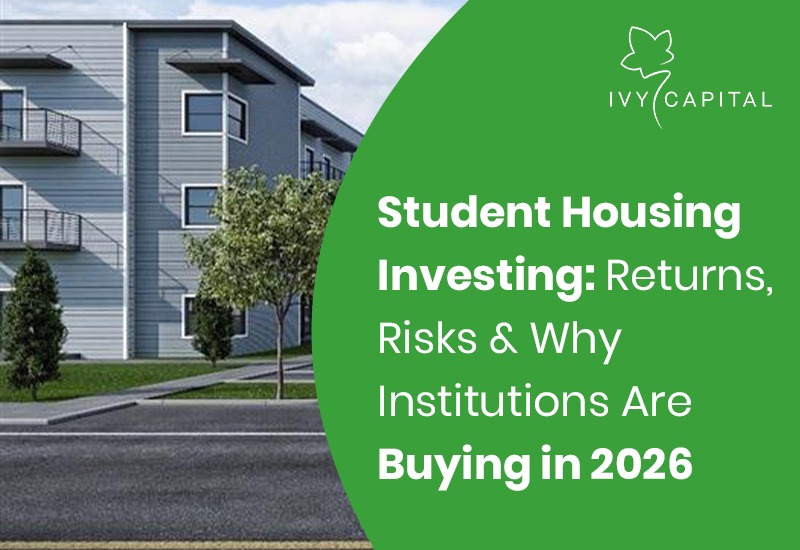
Student housing investing has quietly become one of the most watched corners of U.S. real estate. In 2026, it is no longer a niche strategy. Large institutions, private equity firms, and experienced operators are increasing allocations to student housing real estate investment, and for good reason.
Strong demand, stable occupancy, and university-anchored markets are driving consistent performance, even as other real estate sectors adjust to higher interest rates and shifting work patterns.
For investors looking at passive real estate investing, student housing is now firmly part of the long-term conversation.
What Is Student Housing Investing?
Student housing investing focuses on rental communities designed specifically for college and graduate students. These properties are typically located near major universities and offer features that support student life, such as study areas, modern layouts, walkable access to campus, and shared community spaces.
Unlike traditional apartments, demand in student housing is tied less to employment cycles and more to enrollment trends. This creates a different risk and return profile, one that institutions increasingly value for stability.
At Ivy Capital, student housing investing means improving underperforming properties, enhancing resident experience, and building long-term value in strong Southeast university markets.
Why Institutions Are Buying Student Housing in 2026
Recent market outlooks from Morgan Stanley and Multihousing News point to a clear trend: institutional capital is leaning into student housing as a defensive, income-focused asset class.
Several factors are driving this shift:
Enrollment stability in university-anchored cities
Major public universities across the Southeast continue to show steady or growing enrollment, supporting consistent housing demand year after year.
Supply remains controlled
New development has slowed in many markets due to construction costs and tighter lending standards. Limited new supply supports occupancy and rent stability for existing communities.
Operational performance stands out
Student housing has maintained high pre-leasing levels compared to conventional multifamily, according to recent student housing market reports. This forward visibility is attractive to institutional buyers managing risk at scale.
Income durability
Annual lease cycles, parental guarantees, and diversified tenant bases help reduce delinquency risk, a key reason real estate investment firms are increasing exposure in 2026.
These dynamics have positioned student housing as a reliable income generator rather than a speculative play.
Returns: What Investors Are Seeing
Student housing returns are driven less by rapid appreciation and more by steady cash flow and operational improvement.
In recent institutional outlooks, stabilized student housing assets have shown:
- Strong occupancy supported by university demand
- Predictable leasing cycles with high renewal and pre-lease rates
- Rent growth tied to enrollment trends rather than job markets
For investors seeking real estate for passive income, this consistency matters. Returns come from disciplined execution renovations, better management, and improved resident experience not short-term market timing.
This is where hands-on asset management becomes critical.
Key Risks to Understand
No real estate strategy is risk-free, and student housing is no exception. Smart investors focus on understanding and managing these risks rather than avoiding the asset class entirely.
Market selection matters
Not all college towns are equal. Declining enrollment, oversupply, or weak local economies can impact performance. This is why disciplined buying in selective Southeast markets is essential.
Operational complexity
Student housing requires active management. Leasing cycles, roommate matching, and resident turnover demand experienced operators who understand the asset.
Regulatory and community considerations
Local zoning and community relationships matter, especially near campuses. Long-term success depends on being a good neighbor and a responsible owner.
At Ivy Capital, risk management starts with market selection and continues through daily execution. We do not rely on assumptions. We manage the business, day by day.
Why Student Housing Fits Passive Real Estate Investing
For passive investors, student housing offers a balance that is hard to replicate elsewhere.
- Income backed by education demand
- Diversification beyond traditional multifamily
- Professional management handling daily operations
- Long-term value creation rather than short-term flipping
When paired with an experienced real estate investment firm, passive investors can participate in student housing without dealing with operational complexity.
The key is alignment. Long-term thinking, disciplined execution, and respect for residents create better outcomes for everyone involved.
The Ivy Capital Approach
Ivy Capital focuses on student housing and multifamily communities in Southeast university-anchored cities. We acquire properties with unrealized potential and improve them through renovations, better management, and care for the resident experience.
Our strategy is simple:
- Buy sale
- Buy selectively in growing university markets
- Improve the quality of living for residents
- Manage assets hands-on
- Build long-term value for investors
We don’t chase trends. We invest in places where people live, learn, and grow.
Is Student Housing Investing Right for You?
If you are exploring student housing investing in 2026, the question is not whether the sector works; institutions have already answered that.
The real question is who you invest with.
Execution matters. Market selection matters. Long-term thinking matters.
Visit ivy-cap.com to learn more about Ivy Capital’s approach or get in touch to explore upcoming opportunities.